AI contact center software is designed to help service teams handle more conversations with better speed and consistency. It uses technologies like natural language processing (NLP), machine learning, automation, and analytics to support agents, streamline workflows, and improve customer experiences across channels such as voice, email, chat, and messaging. When built on an omnichannel contact center platform, these capabilities work seamlessly across every interaction point.
When implemented well, AI becomes a force multiplier: customers get answers faster, agents spend less time on repetitive tasks, and leaders gain clearer visibility into performance drivers. The biggest value is not “replacing” people—it is helping your team deliver better service at scale.
Pricing for AI contact centers varies depending on deployment model, feature depth, interaction volume, and the level of automation required. Organizations should evaluate whether pricing is seat-based, usage-based, or outcome-driven, and consider how costs may scale as AI adoption increases across channels. A clear understanding of pricing structures helps ensure that investments in automation, analytics, and intelligent routing translate into sustainable cost savings and long-term ROI.
What is AI contact center software?
contact center ai software refers to a set of capabilities embedded into a contact center platform (or integrated alongside it) that uses AI to automate, assist, and optimize customer service operations. This is the foundation of an ai powered contact center, enabling smarter engagement across channels. It can include:
- Self-service automation (virtual agents, chatbots, voicebots) for common questions and routine transactions
- Agent assist tools that suggest replies, surface knowledge, and guide workflows in real time
- Intelligent routing to connect customers to the best available resource based on intent, urgency, or skills
- Quality and conversation intelligence to summarize interactions and highlight coaching opportunities
- Workforce and performance optimization via forecasting, sentiment trends, and driver analysis
In practice, most organizations deploy AI in phases—starting with high-volume, low-risk workflows—then expanding to deeper automation and optimization as data quality and governance mature. This phased approach enables contact center ai solutions to improve customer experience while minimizing operational disruption.
Top AI Contact Center Software Solutions Powering Smarter Customer Service
AI contact center software helps businesses automate repetitive tasks, improve agent performance, and deliver faster, more personalized customer experiences. From intelligent routing to virtual agents and real‑time analytics, these platforms are revolutionizing how customer support operates. Here are the best AI contact center software solutions available today:
1. Bright Pattern — Best Overall AI Contact Center Software

Bright Pattern is one of the most complete AI contact center platforms on the market. It combines advanced automation, intelligent routing, robust analytics, and real‑time agent support — all in a unified omnichannel interface.
Why It Stands Out
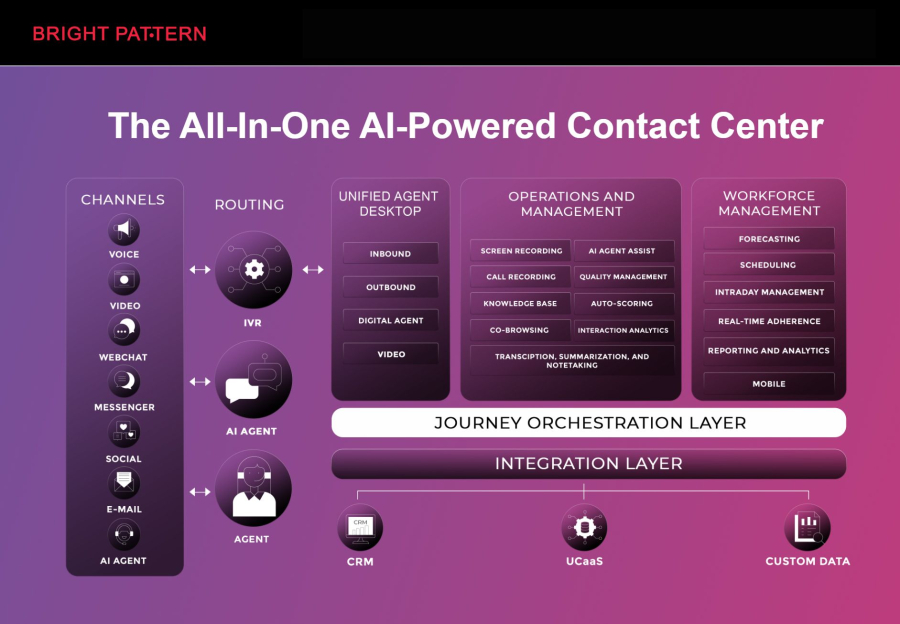
- AI‑driven virtual agents and conversational bots that automate common inquiries
- Intelligent routing that matches customers to the best agent
- Omnichannel support across voice, chat, email, SMS, and messaging apps
- Real‑time agent assist with insights and next‑best actions
- Highly configurable workflows for diverse business needs
- Enterprise‑grade security and compliance for regulated industries
Bright Pattern enables organizations to deliver consistent, efficient, and human‑centric support at scale.
2. Genesys Cloud CX
Genesys Cloud CX uses AI to power predictive engagement, routing optimization, and customer journey analytics. Its strong omnichannel capabilities and robust reporting make it ideal for organizations focused on journey orchestration and deep customer insights.
3. NICE CXone
NICE CXone combines AI automation, quality management, and workforce optimization. Its advanced analytics and real‑time sentiment‑detection tools help teams improve agent performance and overall customer satisfaction.
4. Talkdesk AI
Talkdesk AI offers automated workflows, real‑time agent support, and industry‑specific solutions. Its easy integration with existing business systems and fast deployment make it ideal for growing contact centers.
5. Five9 Intelligent Cloud Contact Center
Five9’s AI software includes virtual agents, intelligent IVR systems, and agent assist tools. It helps businesses transition from traditional call centers to modern, AI‑enhanced contact environments with minimal disruption.
6. Amazon Connect
Amazon Connect, powered by AWS, integrates AI through technologies like Amazon Lex and Contact Lens for speech analysis, virtual agent functionality, and sentiment insights. It’s a scalable solution for cloud‑native customer engagement.
7. Zendesk AI
Zendesk AI integrates automation into helpdesk workflows with conversational bots, AI‑assisted responses, and knowledge base recommendations. It’s particularly effective for teams already using Zendesk’s support platform.
8. Microsoft Dynamics 365 Customer Service
Microsoft’s contact center AI solution blends AI with CRM to offer virtual agents, predictive insights, and real‑time agent guidance. It integrates seamlessly with other Microsoft business tools.
9. Google Cloud Contact Center AI (CCAI)
Google CCAI delivers customizable AI features such as automated virtual agents and speech‑to‑text analytics. It’s a flexible platform suited for organizations with technical resources.
10. Salesforce Service Cloud + Einstein AI
Salesforce Einstein enhances Salesforce Service Cloud with AI‑driven case routing, intelligent recommendations, and smart automation. It’s a powerful choice for businesses deeply integrated with the Salesforce ecosystem.
Why teams adopt AI: measurable benefits that matter
AI contact center software is popular because it directly targets the outcomes leaders care about: speed, consistency, cost-to-serve, and customer satisfaction. The most common benefits include:
1) Faster resolution and shorter wait times
AI can reduce time-to-answer and time-to-resolution through:
- Deflection of repetitive questions to self-service
- Smarter routing that decreases transfers
- Instant knowledge surfacing so agents do not need to search across multiple systems
- Auto-summaries to speed up post-contact wrap-up
2) Consistent service quality at scale
Customers expect consistent answers, regardless of channel or time of day. AI helps standardize service by:
- Providing approved responses and guided flows
- Reducing reliance on tribal knowledge
- Flagging policy-sensitive language in near real time
3) Better agent experience and lower burnout
Agent roles can be demanding, especially when systems are fragmented and customers are stressed. AI can make the job easier by removing busywork and giving agents more confidence in the moment. Common improvements include:
- Less repetitive work through automation of after-call notes and ticket updates
- More clarity via next-best-action prompts and step-by-step guidance
- More time for higher-value conversations that require empathy and judgment
4) Lower cost-to-serve without sacrificing experience
Cost reduction is typically a result of multiple gains working together: fewer contacts handled by live agents, reduced average handle time, fewer repeat contacts, and improved first-contact resolution. The strongest programs pair AI with process improvements so the platform reinforces better workflows, not just faster ones.
5) Clearer operational visibility
AI-powered analytics can identify why customers contact you, what drives dissatisfaction, and which steps in the service journey create friction. This enables leaders to prioritize fixes that reduce contacts long-term—not just handle today’s queue—demonstrating the value of contact center ai solutions and an ai powered contact center in modern customer service operations.
Core capabilities to look for in AI contact center software
Different platforms emphasize different capabilities. Use this list to align features to outcomes.
Customer-facing automation
- Intent detection to understand what the customer wants in natural language
- Virtual agents that handle FAQs and transactional requests (for example, password resets or order status)
- Seamless escalation to a human agent with conversation context preserved
- Omnichannel continuity so customers can switch channels without repeating information
Agent assist and productivity
- Real-time suggestions for responses, troubleshooting steps, or policies
- Knowledge retrieval that pulls the best article or snippet based on intent
- Auto-summarization and disposition recommendations
- Workflow automation (for example, creating a case, tagging it, and updating fields from conversation data)
Routing and orchestration
- Skills-based routing and intent-based routing
- Priority handling for VIP customers or high-risk issues
- Callback and queue management to reduce hold time frustration
Quality management and coaching
- Conversation summaries and interaction tagging
- Automatic quality scoring signals (often used as guidance, then calibrated with human review)
- Coaching insights such as missed steps, policy reminders, or empathy cues
Analytics that drive action
- Contact drivers (top reasons customers reach out)
- Sentiment trends and escalation risk indicators
- Journey insights that show where customers get stuck
- Experimentation support to measure changes in scripts, flows, and knowledge content
Use cases that typically deliver the fastest ROI
Not every workflow should be automated first. High-impact programs usually begin where volume is high and outcomes are easy to measure.
High-volume FAQs and repetitive requests
Examples include shipping status, appointment rescheduling, store hours, billing due dates, and account access questions. These are ideal because the “right answer” is often well-defined.
Password resets and account access support
When integrated securely, self-service can reduce call volume and provide instant resolution. This is especially valuable during peaks (new product launches, seasonal spikes, or incidents).
Order changes and routine transactions
AI can guide customers through simple steps, collect required details, and create a ticket or trigger a workflow—while keeping guardrails around approvals and exceptions.
Real-time agent assist for complex products
For technical support or regulated environments, agent assist can increase accuracy by surfacing the correct troubleshooting path or policy language at the moment it’s needed.
After-contact work automation
Auto-generated summaries and structured data capture can reduce wrap-up time and improve CRM hygiene, which improves reporting and future service.
What “good” looks like: outcomes to expect (and how to track them)
AI programs perform best when success metrics are defined early and monitored frequently. Consider measuring outcomes across customer experience, operational efficiency, and employee experience.
| Goal area | Key metrics | How AI helps |
|---|---|---|
| Customer experience | CSAT, NPS (where used), first-contact resolution, repeat contact rate | Faster answers, fewer transfers, more consistent guidance |
| Speed and efficiency | Average handle time, time to first response, hold time, after-contact work time | Agent assist, summaries, workflow automation, routing optimization |
| Cost-to-serve | Contacts per order/customer, cost per contact, containment/deflection rate | Self-service for routine issues, reduced rework, fewer escalations |
| Quality and compliance | Quality review scores, adherence to scripts, policy exception rates | Guided responses, real-time prompts, automated checks and monitoring |
| Agent experience | Attrition, schedule adherence, time-to-proficiency, eNPS (where used) | Reduced cognitive load, faster onboarding, clearer next steps |
One practical approach is to pick three primary KPIs (for example, first-contact resolution, after-contact work time, and CSAT) and tie every deployment decision to improving at least one of them.
How AI contact center software works (in plain language)
Most AI contact center capabilities rely on a similar pipeline:
- Capture: The platform ingests conversation data (voice transcripts, chat logs, email text) and relevant metadata (customer ID, case type, channel).
- Understand: NLP models detect intent, entities (like order numbers), sentiment signals, and urgency indicators.
- Decide: Business rules and AI predictions determine what should happen next (self-service steps, escalation, routing, suggested answer).
- Act: The system executes automation (create a case, update fields, send a confirmation) or assists the agent with recommended actions.
- Learn: Outcomes feed back into analytics and model tuning, improving performance over time when governance is in place.
Successful teams pay close attention to the “Decide” and “Act” stages—because that is where customer experience is won or lost. AI insights are powerful, but the operational design (workflows, approvals, escalation paths) is what turns insights into results.
Implementation roadmap: from pilot to scaled success
Rolling out AI contact center software does not need to be disruptive. A phased approach reduces risk and creates early wins.
Phase 1: Align on outcomes and pick the right first use case
- Identify top contact drivers and select a use case with clear success criteria.
- Define what “done” means (for example, increase containment for one intent while maintaining CSAT).
- Confirm data sources needed (knowledge base, CRM, order management, identity systems).
Phase 2: Prepare your knowledge and workflows
- Audit knowledge content for accuracy, duplication, and outdated steps.
- Create a clear escalation policy: when should the AI hand off to a human?
- Standardize dispositions and case categories to improve reporting.
Phase 3: Pilot with tight feedback loops
- Start with a limited scope (one queue, one channel, or a small set of intents).
- Collect agent feedback daily and review transcripts for gaps.
- Measure impact against the baseline, not against assumptions.
Phase 4: Scale thoughtfully
- Expand to additional intents and channels once performance is stable.
- Introduce deeper integrations for automation (case creation, refunds, returns, scheduling).
- Operationalize continuous improvement: monthly tuning, quarterly KPI reviews, and knowledge governance.
Building a business case: where value typically comes from
The most persuasive business cases combine efficiency gains with experience improvements. Common value levers include:
- Reduced agent-handled volume through self-service containment for routine issues
- Shorter handle times by reducing searching, re-asking questions, and manual documentation
- Higher first-contact resolution through better routing and real-time guidance
- Lower onboarding costs because new agents ramp faster with guided support
- Improved retention from less burnout and more successful interactions
To keep projections credible, many teams model a conservative scenario first (modest containment and modest handle time improvement), then layer in upside scenarios after the pilot provides real performance data.
Security, privacy, and compliance considerations (practical, not scary)
AI in the contact center often touches sensitive customer data, so governance is a feature—not an afterthought. Strong programs typically include:
- Role-based access control so only authorized users can view sensitive transcripts or analytics
- Data minimization and retention rules aligned to business and regulatory needs
- Redaction of sensitive fields (for example, payment data) in logs and transcripts where appropriate
- Auditability for key actions (who changed a flow, who accessed which records)
- Human oversight for policy-sensitive decisions and customer-impacting exceptions
If you operate in regulated industries, ensure your evaluation includes how the system handles data processing, storage controls, and configurable retention. The goal is to gain the benefits of AI while maintaining trust and accountability.
What to ask when evaluating AI contact center software
A good demo should answer real operational questions, not just show a chatbot. Use these criteria to compare options:
Product and platform fit
- Does it support your channels (voice, chat, email, messaging) in a unified way?
- How well does it integrate with your CRM, ticketing, identity, and order systems?
- Can it preserve context across handoffs so customers do not repeat themselves?
AI capabilities that drive outcomes
- How does routing use intent, skills, and priority rules?
- Can agent assist pull from your knowledge base and adapt to conversation context?
- Does it support summaries and structured field extraction to reduce after-contact work?
Operational control and governance
- Can you set clear guardrails (approved language, escalation thresholds, exception handling)?
- Is there transparency into why suggestions are made (so teams can calibrate and trust them)?
- What tools exist for tuning, testing, and measuring changes over time?
Reporting and continuous improvement
- Can you identify top contact drivers and track deflection by intent?
- Do analytics connect insights to actions (for example, recommend knowledge updates)?
- Can you segment results by queue, channel, customer type, and issue category?
Mini success stories: what AI enables in real-world terms
Even without naming specific brands, the patterns of success are consistent across industries. Here are realistic examples of how AI contact center software delivers wins:
Retail and e-commerce: fewer “Where is my order?” contacts
By automating order status requests and proactively guiding customers to the right resolution path, teams often reduce repetitive inquiries. This frees agents for complex issues like damaged deliveries, returns exceptions, and high-value customer care.
Financial services: faster, more consistent policy adherence
Agent assist that surfaces approved language and workflow steps can improve consistency across large teams. Combined with call summaries and better categorization, leaders gain stronger audit trails and faster coaching cycles.
B2B SaaS: quicker technical triage and better handoffs
AI-driven intent detection and routing can connect customers to the right technical specialist sooner. Summaries and structured notes improve handoffs between support tiers and reduce repetition for the customer.
Getting started: a simple checklist for your first 30 days
- Choose one measurable use case with high volume and low ambiguity.
- Baseline your metrics (handle time, CSAT, transfer rate, repeat contacts).
- Clean up knowledge content for the selected use case.
- Define escalation rules and ensure context passes to agents.
- Train a small pilot group and collect feedback from agents and supervisors.
- Review transcripts weekly to identify gaps and refine flows.
- Expand gradually once performance is stable and governance is in place.
The bottom line
AI contact center software helps teams deliver faster, more consistent service while improving agent productivity and operational visibility. The biggest wins come from matching AI capabilities to clear outcomes, starting with targeted use cases, and building a continuous improvement loop around knowledge, workflows, and measurement.
When you treat AI as a service accelerator—one that supports your people and strengthens your processes—you create a contact center that scales with demand, adapts quickly, and earns customer trust conversation by conversation.
